
Natural Language Processing
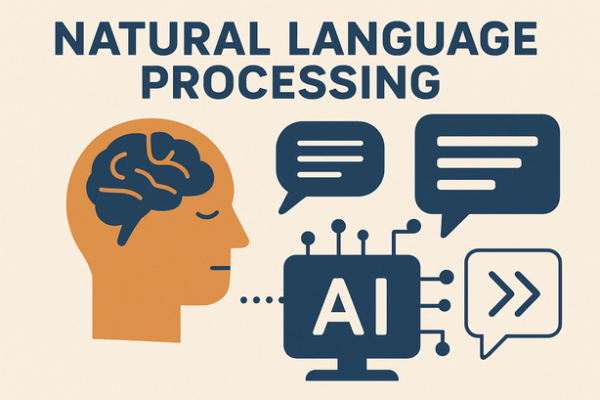
Natural Language Processing is transforming the way humans and machines interact.
Natural Language Processing (NLP) is a branch of artificial intelligence (AI) that focuses on enabling computers to understand, interpret, and generate human language. Whether it’s written text, spoken words, or even emojis, NLP is what allows machines to interact with us in ways that feel natural and intelligent.
From voice assistants like Siri and Alexa to translation apps and chatbots, NLP is behind many of the tools we now use daily—tools that are reshaping how we communicate, search for information, and do business.
Why NLP Matters
Human language is complex, messy, and full of nuance. Words can have multiple meanings depending on context. Slang, sarcasm, grammar errors, and regional dialects add to the challenge.
For example:
“I can’t recommend this enough.” – Is that positive or sarcastic?
“The chicken is ready to eat.” – Is the chicken cooked or hungry?
NLP helps computers decode these ambiguities, enabling machines to understand not just what we say, but also what we mean.
What NLP Can Do
NLP powers a wide range of everyday applications:
1. Speech Recognition
NLP enables devices to convert spoken language into written text. This is what allows:
Voice typing on smartphones
Transcription services like Otter.ai
Digital assistants to respond to spoken commands
2. Text Classification
This involves categorizing text into specific groups:
Email spam filters (spam vs. not spam)
Social media monitoring (flagging hate speech or threats)
Sentiment analysis (is a customer review positive or negative?)
3. Language Translation
Services like Google Translate and DeepL use NLP to understand sentence structure, context, and grammar in one language and accurately convert it into another—far beyond simple word-for-word translation.
4. Chatbots and Virtual Assistants
Customer service bots on websites and AI agents like Siri, Alexa, and Google Assistant rely on NLP to understand questions, search for answers, and reply conversationally.
5. Autocorrect and Predictive Text
Your phone’s keyboard that predicts what you’ll type next or fixes typos uses NLP models trained on massive amounts of text data.
6. Text Summarization
NLP can automatically shorten documents while preserving meaning—a feature used in news apps, research tools, and document management systems.
7. Named Entity Recognition (NER)
NER identifies proper names, places, dates, and other key entities within a text—useful for information extraction in journalism, law, and healthcare.
🔍 How NLP Works
NLP combines linguistics, computer science, and machine learning. Here’s how the process typically works:
Text Preprocessing
This involves cleaning and preparing raw text:Removing punctuation, stop words (like “the” or “and”), and extra spaces
Converting text to lowercase
Tokenization (splitting text into words or phrases)
Parsing and Syntax Analysis
Understanding sentence structure using grammar rules—what’s the subject, verb, object?Semantic Analysis
Going beyond grammar to understand meaning—what is the sentence actually saying?Machine Learning Models
NLP tools use algorithms and large datasets to train models that improve over time. Recent breakthroughs like transformers (e.g., BERT, GPT) have made NLP much more accurate and conversational.
Challenges in NLP
Despite major advances, NLP still faces big hurdles:
Ambiguity: Many words and phrases can be interpreted multiple ways.
Context Understanding: Machines struggle with sarcasm, idioms, or cultural references.
Bias: NLP models can reflect or even amplify biases present in their training data.
Multilingual Complexity: Each language has unique grammar, slang, and structures.
Real-World Examples of NLP
Amazon Alexa: Listens to your commands and performs tasks like playing music or checking the weather.
Google Search: Interprets what you’re looking for even if your query isn’t perfectly worded.
Gmail’s Smart Compose: Suggests sentences while you type based on context and tone.
Customer Service Chatbots: Automate responses and escalate issues when necessary.
Financial Analysis Tools: Summarize earnings calls or legal documents for investors.
The Future of NLP
NLP is evolving rapidly, thanks to large-scale models like ChatGPT, Claude, and Gemini, which can now understand and generate language at near-human levels.
In the future, we can expect:
More context-aware AI conversations
Real-time speech-to-speech translation
Emotion-aware assistants that adapt tone
Deeper integration with robotics, helping machines interact more naturally with people
Our Recap
Natural Language Processing is quietly transforming the way humans and machines interact. It bridges the gap between human communication and digital understanding, making technology more accessible, responsive, and helpful.
Whether you’re chatting with a bot, searching with your voice, or translating a foreign menu, NLP is the intelligence behind the scenes—bringing words to life in the digital world.